Begin with one complete outfit you have already worn. Use a private reference—the clothes themselves, a note, a photo, or memory—to recover the same combination. Check only whether a relevant external constraint has changed. If nothing material has changed, repeat it unchanged. If something has, stop and use the current weather, venue, or care source for that separate question. A repeat does not need to become a new outfit decision.
Start from the whole outfit
The starting condition matters: the outfit is already complete. You are not choosing a base, comparing alternatives, or changing one piece. You are recovering a known combination. A private reference only needs to remind you which items went together; it does not prove that the outfit was successful, comfortable, suitable, clean, flattering, or right for another occasion.
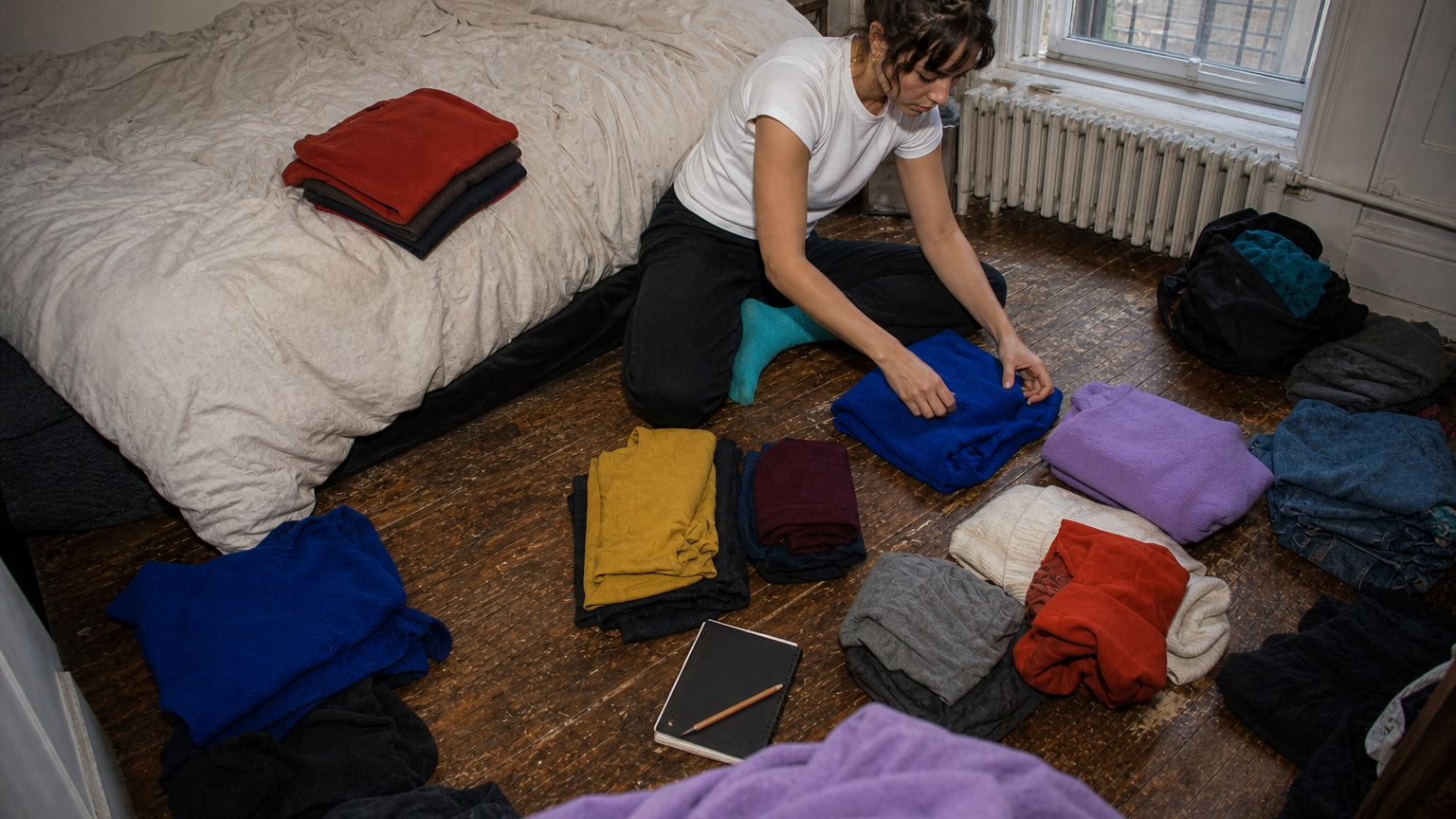
Use the least elaborate reference that works for you. The clothes on a chair may be enough. A short note may be enough. So may a memory. There is no need to create an inventory, save a look, upload an image, or share a photo in order to repeat one combination.
Check one thing before you repeat it
Ask one question: has a relevant external constraint changed? That might be a weather forecast, a venue instruction, or a care-related fact. This article does not answer those questions. It only keeps them separate from the act of repeating the outfit. If no relevant constraint has changed, there is nothing here to solve.
Repeat unchanged or route the question
When the complete outfit is still available and the relevant condition is unchanged, repeat it unchanged. When the condition has changed, route only that question to its current source. A changed forecast calls for weather information; a written requirement calls for the responsible source; a care question calls for the applicable care information. Do not silently redesign the outfit and call that a repeat.
What repetition does not prove
Repeating an outfit does not prove that it works for everyone, that it fits a new context, that it is safe or clean, or that it has a particular social or environmental effect. It is not a wear count, a style score, a confidence exercise, a cost calculation, or a reason to purchase something.
Sources and limits
The United Nations Environment Programme encourages valuing and being creative with clothes already owned in its 2025 discussion of fashion waste. That is sector context, not evidence that repeating one outfit produces a measurable result. This method stays narrower: recover one complete combination, check for a changed constraint, then repeat or route the separate question.
CLOOTHE Editorial reviewed this guidance on September 4, 2026. It is product-independent and does not claim that CLOOTHE records, retrieves, or recommends outfits.